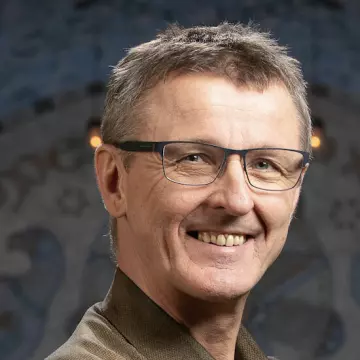
Washington: He is a long-time faculty member at Howard, a historically black university. His analysis of the Trump project is harsh. Where are the black Professors in this?
Project 2025: - We have seen this playbook before, Ethelbert Miller observes. - You still have to get upp in the morning. Or like my mother would say: Donald Trump – that’ll pass.Photo: Toholenre Oks
Will America’s democratic institutions survive Trump?
As unrest spreads, researchers and lecturers at universities are doing what they can to keep activities running as normally as possible. In laboratories and lecture halls, it’s business as usual. But the disruptions are mounting. What are faculty thinking about their situation—now, in the near future, and in the longer term? How are the students doing?
In a series of articles funded by the Fritt Ord Foundation, The University Newspaper and Uniforum will visit a number of universities in the United States this fall. We report on the situation as it is experienced on the ground.
Denne artikkelen er publisert både på norsk og engelsk. Den norske versjonen finner du her.
E.
Ethelbert Miller has been with Howard for four decades, as a teacher, a poet, and a literary activist. He was chairperson at the Institute for Policy Studies, a progressive think tank in
Washington.
Howard
University is probably the best-known HBCU «Historically Black Colleges and
Universities». Former vice president and presidential candidate Kamala Harris
graduated from Howard. It was here she held her first speech after losing the
presidential election.
Miller is
now retired, and we meet outside campus, at a café in Dupont Circle. During the
interview, the professor wears a bright yellow baseball cap, with a logo I take
to be the letter “H” which I interpret as H for Howard. At the end of the
interview, however, the former Howard faculty reveals himself as a passionate
baseball fan. At some point, he took a liking to Japanese baseball teams.
Hence, the yellow cap - belonging to Hanshin Tigers.
Apartheid
As a retiree from Howard, he observes the university where he served on the faculty for more
than forty years with some distance. What occupies him now is the direction in
which his country is being moved by Trump and MAGA. So, which direction is the
United States heading? The short answer is this:
Residental area, central Washington. The protests take place in many waysPhoto: Tore Oksholen
- We’re
heading the South African way. What’s taking place now, directed by Project
2025, is no different from South Africa under apartheid.
Fakta
E. Ethelbert Miller
Former chair of the Institute for Policy Studies. He was chair from 2007-2017.
Former director of the African American Resource Center at Howard University (1974-2015).
Focus areas: Afro-american litterature and culture, activism in academia and society.
1994: PEN Oakland Josephine Miles Award for the antology In Search of Color Everywhere.
Honorable doctorate in litterature at Emory & Henry College, 1996.
At once,
the reader may ask: Why are we not seeing the HBCUs – Howard in particular –
protesting more loudly? As Miller himself asks rhetorically:
- How often
do you see Howard faculty in the press, expressing their resentment toward
Trump’s attack on academia?
Not often,
he replies himself. In fact, almost never.
We shall
return to that. First, Miller on Trump’s scheme, and where the Democrats are in
all this.
The pushback that didn't come
- When I
look at the Heritage Foundation’s Project 2025, that was something they were
working on back during the time of Ronald Reagan. The policies we see being
implemented now – like phasing out the Department of Education – all these
things were proposed many years ago. They’ve been trying to do this before. The
playbook is still the same, he concludes.
As for the
Democrats:
- The
opposition, the pushback, has not been what I anticipated. I expected more.
When we look at what Trump has been able to do, he’s had years in exile to
prepare for this. If you look at what he’s done in just nine months, it’s
unbelievable. I’m very disappointed in the Democratic leadership.
So what are
the Democratic Party doing wrong?
Soldiers from the National Guard on patrol in central Washington D.C.Photo: Tore Oksholren
- They
always talk about bipartisanship, Miller answers.
- That’s the
problem with their leadership. They’re talking about a two-party approach, but
with today’s Republican Party, bipartisanship doesn’t exist anymore. The
Republican Party has become the MAGA party. The Democrats don’t get it. If you
flip it, I’ve never heard any person in Republican leadership talk about
bipartisanship. What we see today is no compromise. What the Republicans say
is, ‘I don’t even want to talk to you, okay?’
Academic freedom not on the agenda
The
Democrats still haven’t realized that the Republican Party has changed and
become something else.
- When we
look at people like George Romney – a lot of people retired – George Romney,
George Bush, they were the old Republican Party. They were good people, not
extremists. The last person in a leadership position was probably John McCain.
Bush, Cheney, that’s the old party. They were conservative, not extreme. But
that party’s gone, Miller says.
Miller
keeps in touch with his former colleagues at Howard. How do the faculty there
react to the recent attacks on universities?
- Howard
University is a historically Black school, and it hasn’t changed. The people
who are the most active about academic freedom at Howard are white faculty. The
others are just going about teaching their classes and stuff like that, he
says.
Many of the
faculty at Howard are concerned about their classes and how much they’re
getting paid, Miller explains.
- That’s
what they’re into. Academic freedom, things of that sort, are not on the
agenda. And I say that in terms of friends of mine who try to organize faculty.
It hasn’t changed, he says.
Black colleges are conservative
And when
one thinks about it, historically Black colleges are conservative, Miller
reflects.
- They may
be radical around issues of race, but they’re conservative about everything
else. If you look at the Black community, it’s extremely religious. Even a
group like the Nation of Islam, Black Muslims – they were very radical in terms
of race, but very conservative in every other respect – conservative in terms
of women’s issues, they don’t even deal with gay issues. Basically, they want
the woman to be in the kitchen, be a good Muslim woman, and sew my buttons.
When we look at organizing, Black people in this country have no concept of
class, he says.
What about
movements like Black Lives Matter – where do they stand in this?
- Well, the
Black Lives Matter movement is international. It galvanized young people,
almost like the Occupy Movement. The problem with those movements is they’re
leaderless. I saw this several times, even here: It would be a very peaceful
Black Lives Matter demonstration and protest, but right around the end of the
march, you would find a number of white kids dressed in black, anarchists, who wanted to throw rocks at the police, throw rocks at the Bank of America or
whatever, and all of a sudden, what happens? It discredits the Black Lives
Matter movement, he says.
A generation traumatized
- Miller: I have tried for some time to schedule interviews
with faculty currently working at Howard, without success. Do you think the
reason might be that they’re not particularly concerned about academic freedom
and the like?
- Look at it
this way: when you read the media, your media, do you see anybody from Howard
University mentioned? The answer is no, he states.
- You’re
describing two developments. On one side, Project 2025 is making the United
States resemble South Africa under apartheid. On the other, you’re describing
many African American citizens and Black faculty at universities like Howard
who don’t seem particularly worried about what’s going on?
To that
question, the former Howard scholar turns to describing the disappointment many
Black voters felt when Kamala Harris lost the election to Trump.
- You’re
talking about a generation that’s been almost traumatized. It’s going to take
them a long time to get over that, a long time to get over that loss and
disappointment. A lot of people go through a phase where they don’t even want
to hear about politics anymore. They just turn it off.
When what you need is short memory
This
doesn’t mean the situation is hopeless, he points out.
- Kamala
Harris lost the election. You still have to say, okay, how can I maintain that
enthusiasm? How can I channel that? I’m not going to give up. I have to reboot
myself, okay? I have to rededicate myself. I have to work harder, okay?
Ethelbert
Miller, the former Howard faculty member and the baseball enthusiast, then turns to his favorite
game to explain what traits are needed.
- If you,
for instance as a relief pitcher, give up a home run and your team loses, what
you then need is a short memory.
Because there will be another day, another
game, another election.
- One of the
key things in African American culture is the blues. And the blues is filled
with joy, filled with resilience. You say, okay, I might lose my job today, but
I’ve still got to get up in the morning. So, have a good morning. Or like my
mother would say: Donald Trump, that’ll pass.