Her grants were cancelled - to fund statues of «Great Americans»
Washington: Professor Diana Owen had three major federal grants cancelled. Then she was told that the money from one of them had been redirected to fund statues of «Great Americans.»
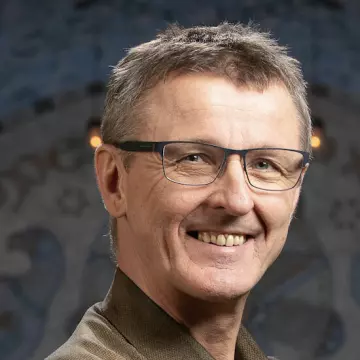
-They wrote that what we were doing was worthless. They insulted us at the same time as canceling and taking the money away., Diana Owen tells.Photo: Tore Oksholen
Will America’s democratic institutions survive Trump?
As unrest spreads, researchers and lecturers at universities are doing what they can to keep activities running as normally as possible. In laboratories and lecture halls, it’s business as usual. But the disruptions are mounting. What are faculty thinking about their situation—now, in the near future, and in the longer term? How are the students doing?
In a series of articles funded by the Fritt Ord Foundation, The University Newspaper and Uniforum will visit a number of universities in the United States this fall. We report on the situation as it is experienced on the ground.
Fakta
Diana Owen
Professor of Political Science in the Master’s Program in Communication, Culture & Technology (CCT), American Studies Program.
Director of the Civic Education Research Lab (CERL) at Georgetown.Research areas: Media and politics, voting behavior and elections, political socialization, civic education and engagement — with a particular focus on youth and “high-need” schools.
Received the Established Leader Award from the American Political Science Association’s Civic Engagement Section in 2024.
Denne artikkelen er publisert både på norsk og engelsk. Den norske versjonen finner du her.
Diana Owen
is a tenured professor of political science at Georgetown University in
Washington, D.C. Her field of research is civic education. Two of her canceled
grants came from the Department of Education and one from the National
Endowment for the Humanities (NEH).
- The one
from NEH they pretty much wiped out, she says.
Soon after,
she and her team learned that the funds withdrawn from these canceled grants
had been redirected to the creation of the “National Garden of American Heroes”, a long-promised park of statues on the
National Mall.
- That’s
one of his pet projects, she continues. «He» being President Donald Trump.
The
National Mall is the broad expanse between the Washington Monument and
Congress, occupied primarily by the Smithsonian museums. It is a vast, open
space, meant to remain that way.
- Why were
your grants canceled?
- They
claimed the entire grant was against the Trump administration’s policies
because it engaged in illegal DEI, Diversity, Equity, and Inclusion, or other
topics they labeled as ‘un-American,’ she replies.
DOGE – the
Department of Government Efficiency was an initiative originally led by Elon
Musk during Trump’s first months in office, aimed at slashing the federal
bureaucracy.
The Mall - to day a serene space. This is were Trump plans to locate his monument park of «Great Americans.»Photo: Tore Oksholen
- It was
awful, Professor Owen continues.
- They wrote
that what we were doing was worthless. They insulted us at the same time as
canceling and taking the money away. Concerning the second grant, they wrote
that it violated Title VI of the Civil Rights Act. I suppose that’s because we
work with high-need kids.
A
University with History
Georgetown
was established in 1751 as a commercial hub and port settlement along the
Potomac River. In 1789, Georgetown University was founded as the first
institution of higher education in the United States. A year later, in 1790,
Washington, D.C., was established as the nation’s capital.
Georgetown
has a strong international reputation in political science, international
relations, and diplomacy.
Owen and
her colleagues have found ways to navigate around these cancellations to secure
alternative funding.
- It looks
like things are leveling off in the Department of Education. Now it’s people in
the National Institutes of Health who are feeling the heat. I’ve been fortunate. Others haven’t been as lucky. One thing that distinguishes Georgetown, among
many, is that only ten percent of our budget is supported by federal grants, so
it’s a much smaller share.
- Now, we
didn’t get any, so we’re pulling back on programming. Nobody got a raise, all
those things. But still, I feel fortunate to be here.
Soldiers on
Campus
On the way
to campus, we pass a small unit of National Guard soldiers on patrol.
Washington, D.C., was the first city to have troops deployed, strongly against
the mayor’s will.
Soldiers from the National Guard patrolling Georgetown.Photo: Tore Oksholen
At her
office, Owen confirms that soldiers have been seen on campus.
- Mainly to
use our restrooms, she says with a half-smile.
- But we’ve
seen them standing right outside, guns drawn. Doing what? Taking pictures of
squirrels. And I’m not exaggerating. They were just standing there. No crime,
nothing happening.
The
soldiers are also seen around other parts of the city, including near the
Smithsonian.
- There are
crime-infested areas in this city, but that’s not where they’re patrolling.
I’ve personally seen them stopping cars and conducting some sort of checks. I
don’t know for what.
It’s easy
to make jokes about the spectacle, she admits, but having soldiers roaming the
streets is no laughing matter.
- What’s
kind of sad is that students are getting used to this, because they’ve been
posted in places where they live, Owen reflects.
Fear and
Fatigue Among Faculty
Sanitizing history is central to the MAGA project, according to Diana Owen.Photo: Tore Oksholen
Faculty at
Georgetown react differently to what has happened to their university, Owen
says, their reactions depending on how directly they’ve been affected.
- People
who haven’t had grants taken away tend to think this isn’t something they need
to worry about. I don’t understand how they can just pretend it’s not
happening. I’m not sure they’re even paying attention to the news. It disturbs
me, that people can be so oblivious to what’s going on. It’s upsetting.
She
describes tense faculty meetings: some colleagues deeply anxious because
they’ve seen agents outside their homes or soldiers in the streets, while
others lash out in ways that distress her.
- We do
have a supportive administration here. Still, you wonder. Is someone going to
pick up the phone, and the next thing you know, you’re in trouble? It does make
you self-censor a bit.
- Do you
worry someone might talk to the government about other faculty?
- I don’t
expect that would happen, she replies, thinks for a while, adds:
- Still,
I’ve decided to hold back at faculty meetings.
A War on
Culture
- You’re a
political scientist, and you’ve been told that part of the money from your
canceled grants will fund Trump’s monument project. How important would you say
this ‘war on culture’ is to the broader MAGA movement?
- I think
it’s central to the entire MAGA project, to sanitize history. It’s a key
component of Christian nationalist ideology, as well as a way to downplay the
role of other races in American history, she says.
The
cultural-war dimension of MAGA, she believes, is one of its strongest and most
resonant themes.
- It’s
easier to communicate that to his followers than some of the more complex
economic issues, like the current debate over the shutdown, or how the budget
impacts healthcare and other programs.
The assault
on American universities, she says, is also part of that broader cultural
campaign.
- They’re
going after not only the African American Museum but the whole Smithsonian, the Museum of American History, everything. And now they’re targeting the
national parks. They’ve already had some success changing the signage at sites
commemorating slavery.
- So what’s
his goal, you assume? To erase the slavery part of history?
- Slavery,
and other things he sees as negative portrayals of American history, to just
make America shine. His view is that American history should be more positive
and shouldn’t dwell on the darker parts.